| Rollsigns from Leatherhead, England London & Country |
General Information about these blind sets:
A typical British bus of the 1980s would have rollsigns at the front.
They consisted of a "three track" number blind, three separate rollers
each with the digits 0 to 9 and maybe some letters too, enabling any
route number to be displayed, and a wider rollsign for the destination.
Sometimes, the window for that wider rollsign would be masked so that
only a single line was displayed, known as a Type 2 sign. If it wasn't
masked, then a deeper display could be shown, including more
information such as points the bus will pass through, as well as the
end destination, known as a Type 1 sign. Many buses didn't have any
displays for side or rear. If they did, it would usually just be another
triple route number only.
Not every bus was fitted with triple route number plus
destination. Operators could specify other layouts.
London Transport/London Buses were one example.
Information about this blind scroll seen here:
The top part is printed on Dayglo yellow, and seems to contain routes
which were at the time run by a different operator, Epsom Buses. The
rest of it on white is original from Leatherhead Garage. It is possible
that at the round of bidding, London & Country may have won the
contracts for Epsom. To save getting complete new blinds made,
they might have just added the Dayglo section to the existing blind.
Over time, the Epsom routes were taken over by another contractor.
Referencing a Surrey bus map and a couple of timetables from
1993, routes on the white section can be identified:
• E1 (Epsom<>Merland Rise)
• 293 (Merton Abbey <> Epsom with Sunday service to Brettgrave)
• 406 (Kingston <> Walton-on-the-Hill with journeys to Redhill)
• 479 (Kingston <> Guildford)
• 408 (West Croydon <> Guildford)
• 465 (Horsham <> Kingston with journeys to Ham)
• 406F (Epsom Station <> Epsom Downs)
Notable that the panel for the route 406F, which operated only when
horse racing events were taking place on Epsom Downs, does not
provide for the "F", as the buses would have only been fitted with
three-track number blinds. These corresponding route numbers also
appear on the back of the sign where the name and alignment line
are printed. Referencing a later Surrey bus map dated 1995, London
& Country had taken over route 516 by that time, which accounts for
various Epsom / Leatherhead / Headley / Boxhill / Dorking /
Woodbridge displays. Some destinations like Cobham, Old Woking
and Guildford displays on the Dayglo section are more of a mystery.
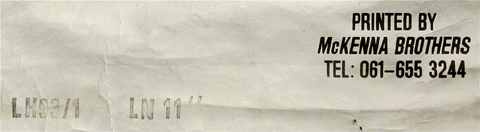
On either end of the scroll, along with the McKenna Brothers
branding, there's a stamp that reads "LH93/1 LN 11' ' " (seen
below). It appears that the stamp was added after the addition
of the Epsom Dayglo section. This stamp breaks down as follows:
• LH = Leatherhead Garage
• 93/1 = Printed in 1993, Type 1 scroll
• LN = Designed for a Leyland National bus
• 11' ' = 11 inch tall exposure display
A typical British bus of the 1980s would have rollsigns at the front.
They consisted of a "three track" number blind, three separate rollers
each with the digits 0 to 9 and maybe some letters too, enabling any
route number to be displayed, and a wider rollsign for the destination.
Sometimes, the window for that wider rollsign would be masked so that
only a single line was displayed, known as a Type 2 sign. If it wasn't
masked, then a deeper display could be shown, including more
information such as points the bus will pass through, as well as the
end destination, known as a Type 1 sign. Many buses didn't have any
displays for side or rear. If they did, it would usually just be another
triple route number only.
Not every bus was fitted with triple route number plus
destination. Operators could specify other layouts.
London Transport/London Buses were one example.
Information about this blind scroll seen here:
The top part is printed on Dayglo yellow, and seems to contain routes
which were at the time run by a different operator, Epsom Buses. The
rest of it on white is original from Leatherhead Garage. It is possible
that at the round of bidding, London & Country may have won the
contracts for Epsom. To save getting complete new blinds made,
they might have just added the Dayglo section to the existing blind.
Over time, the Epsom routes were taken over by another contractor.
Referencing a Surrey bus map and a couple of timetables from
1993, routes on the white section can be identified:
• E1 (Epsom<>Merland Rise)
• 293 (Merton Abbey <> Epsom with Sunday service to Brettgrave)
• 406 (Kingston <> Walton-on-the-Hill with journeys to Redhill)
• 479 (Kingston <> Guildford)
• 408 (West Croydon <> Guildford)
• 465 (Horsham <> Kingston with journeys to Ham)
• 406F (Epsom Station <> Epsom Downs)
Notable that the panel for the route 406F, which operated only when
horse racing events were taking place on Epsom Downs, does not
provide for the "F", as the buses would have only been fitted with
three-track number blinds. These corresponding route numbers also
appear on the back of the sign where the name and alignment line
are printed. Referencing a later Surrey bus map dated 1995, London
& Country had taken over route 516 by that time, which accounts for
various Epsom / Leatherhead / Headley / Boxhill / Dorking /
Woodbridge displays. Some destinations like Cobham, Old Woking
and Guildford displays on the Dayglo section are more of a mystery.
On either end of the scroll, along with the McKenna Brothers
branding, there's a stamp that reads "LH93/1 LN 11' ' " (seen
below). It appears that the stamp was added after the addition
of the Epsom Dayglo section. This stamp breaks down as follows:
• LH = Leatherhead Garage
• 93/1 = Printed in 1993, Type 1 scroll
• LN = Designed for a Leyland National bus
• 11' ' = 11 inch tall exposure display








| This blind has 56 exposures. The image of it has been enlarged 1.5x to enhance detail. Some of the exposures on the blind are grouped together so that the readings overlap one another, to shorten the scroll length and be an overall cost saver. For instance, the last three lines of text are two different readings: "SEASIDE SPECIAL" and "SPECIAL SERVICE". |
| A special THANK YOU to Malc McDonald for assistance with the historical information. |