| Rollsigns from Marion, IN |
| Public transportation in Marion began with the Marion Street Railway in 1889. Mule driven passenger cars provided service with an initial route between the Veterans administration at the south end of town to 14th and Branson St where the Nickel Plate and Pennsylvania railroad stations were. Years after, lines were added to Washington Street, to the east side of town, an extension of the Veterans Administration line to 34th Street and added eastbound track along Lincoln Blvd. In 1891 the network was electrified, however, even with this improvement, competing companies began to form. Queen City Electric Railway incorporated in 1891, but it wouldn't be until late into 1982 when tracks were laid. They competed directly with Marion Street Railway only for two years when they went out of business. QCER was sold at auction and was acquired by Union Traction Company in 1895, unifying streetcar service across the city. The combined Marion City Railway Company flourished until 1899 when the Union City Traction Company bought them out. Along with city service, there were three companies that had interurban electric railway terminals in Marion at this time. Two of them - Union Traction and Indiana Railways and Light, also had streetcar service within Marion. Meanwhile in 1899, the Marion Transit Railways was franchised to provide both streetcar and interurban lines. In January of 1900 a single line to Marion College was built after lobbying from the public and students when the college moved the south, and the Union Traction Company chose not to open a line of their own. They also introduced service to the Veterans Hospital. After a few months though, Union Traction Company reversed this decision and opened their own line to the college. Fare competition ensued, and Union Traction could provide service for a cheaper rate. This eventually let to Marion Transit Railway going out of business and the operations were purchased by Union Traction Company in September of 1991. They reorganized a few days later, and most of the stock holders of the old Marion Transit were put in charge of the Union Traction subsidiary until they closed it down in 1903. Marion Railways, Inc. was the last trolley line in Marion. When the last interurban left Marion, 14 miles of track was left behind in Marion, as well as the line to Gas City. The tracks and power lines in Marion were purchased for a low rate by three business men who wanted to keep the streetcars running. Though Marion was one of the earliest towns to have street cars, it was well known for being one of the last towns to keep them running. Unfortunately over time, Marion Railways could no longer afford to maintain the rails, so the trolleys were replaced with buses in 1947. After this point, transit history becomes sketchy. Miller Bus Lines was believed to have provided service starting in 1956 to some point. The current City of Marion Public Transportation has operated out of the city's transportation department for several decades. They offer both fixed route and ADA compliant on-demand service all over the City of Marion and outside city limits to the Ivy Tech College Campus. |


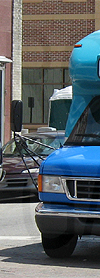
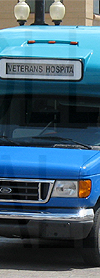
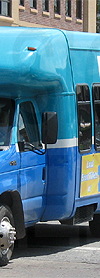
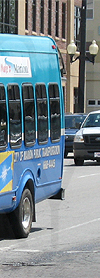
| This mylar rollsign set was retrieved from City of Marion Public Transportation's July 2003 built Ford E450 cutaway bus #1. Neither sign has a print date, but they're the only signs that occupied this bus while in service for Marion . Each sign has 15 exposures. The images of these rollsigns have been enlarged to 1.5x that of other signs on this site to show better detail. |
| When it was still in service, City of Marion Public Transportation July 2003 built Ford E450 cutaway bus #1, displaying the front (and side) rollsigns shown here, is seen northbound on Adams Street at 3rd Street (State Road 18) in downtown Marion on June 6, 2008. |




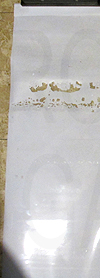
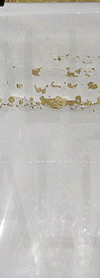
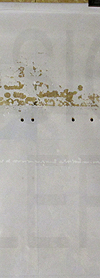
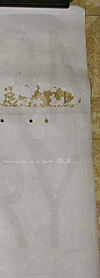
| The side rollsign (right) appears to have been left on the beginning blank for an extremely long time without being rolled. The mylar's exposure to the sun and the elements degraded the scroll at that point. (see above). The white background coating separated from the mylar core and has been flaking away badly. The clear mylar core had also weakened to the point that it had started to tear, and one small section within that area had actually broken off. The original beginning blank to the first exposure was 32 3/4 inches long. To preserve the quality and integrity of the sign, the beginning blank was trimmed back to 21 inches long to remove the damaged and weakened area of the scroll. The rollsign image here was drawn to show its prior full length as it was originally designed. |

