| Rollsigns from Golden Gate Transit, CA Marin, Sonoma, San Francisco and Contra Costa Counties |
This mint condition curb side mylar route
number rollsign was designed for one of
Golden Gate Transit's GM New Look buses.
The rollsign was made by Transign, but has
no sign tag or print date. It has 36 exposures.
This rollsign was graciously donated
to Rollsign Gallery by Steve Souza.
number rollsign was designed for one of
Golden Gate Transit's GM New Look buses.
The rollsign was made by Transign, but has
no sign tag or print date. It has 36 exposures.
This rollsign was graciously donated
to Rollsign Gallery by Steve Souza.



| Crossing the San Francisco Bay by ferry dates back to 1850 when ferryboats operated between San Francisco and Oakland. In 1868, the Sausalito Land and Ferry Company purchased waterfront land in Sausalito and proceeded to layout streets and subdivide the central waterfront into view lots. They also began to operate ferry service between Sausalito and San Francisco, in part as a promotion for real estate development. The Princess, a small steamer was the first Sausalito ferry to serve San Francisco. A rail line also attracted people to what became a major transportation hub. In 1875, the North Pacific Coast Railroad purchased the ferries. Then in 1907, the Northwestern Pacific Railroad purchased the railroad lines serving Marin County and the ferry service serving San Francisco. Sausalito became the hub of passenger transportation. In 1920, due to the unresponsiveness of the Northwestern Pacific Railroad to the demand for auto ferries passage, a new ferry company, the Golden Gate Ferry Co., was inaugurated and offered auto ferry service between San Francisco and Sausalito. Prior to the opening of the Golden Gate Bridge, ferry and rail service flourished. Following the opening of the Bridge in May 1937, ferry service between Marin and San Francisco declined and eventually came to an end on Friday, February 28, 1941. For the next 29 years, driving across the Bridge was the only way to travel directly between Marin and San Francisco. Just over 3.3 million vehicles crossed the Golden Gate Bridge during the first full year of operation. By 1967, annual crossings had grown over 750 percent to 28.3 million vehicles. The Bridge was close to reaching the saturation point and the public needed an alternative to the private automobile. As the traffic congestion continued to increase, a number of studies were undertaken to identify alternate means of travel between Marin County and San Francisco. The May 1967 San Francisco-Marin Crossings, prepared by the Division of Bay Toll Crossings, State of California explored numerous transportation solutions including building a second bridge, a bridge to Angel Island connecting to Tiburon, and an underwater tube linking San Francisco and Marin. A number of lower deck options for the Bridge were also investigated. As a fixed, six-lane roadway, the Bridge could not be as easily expanded to accommodate traffic growth as was the case with other highways. At the time, Greyhound provided transit between Marin County and San Francisco and it was so unprofitable that management wanted to abandon it. Marin County Transit District (now known as Marin Transit) considered taking over the existing Greyhound bus system as a commute service to San Francisco. By the late 1960s, the span was at capacity during the morning commute. The original construction bonds were due to be retired and the District had approximately $22.8 million in reserves. An innovative solution was needed to provide much needed relief to the traffic congestion. Released in July 1969, Arthur D. Little, Inc.’s report, Feasibility Study of San Francisco-Marin Ferry System, funded by Marin County Transit District and the City and County of San Francisco, indicated that a ferry system was feasible and should be implemented and operated by the Golden Gate Bridge and Highway District. On November 10, 1969, the California State Legislature passed Assembly Bill 584 authorizing the District to develop a transportation facility plan for implementing a mass transportation program in the U.S. Highway 101/Golden Gate Corridor. This was to include any and all forms of transit, including ferry. At that time, the word “Transportation” was added to the District name to indicate its new commitment to public transportation. The Legislature did not give the District the authority to levy taxes, nor could Bridge tolls support local transit services – only intercounty, regional service could be subsidized by Bridge tolls. The mandate was clear – reduce traffic congestion on the Bridge and the adjacent corridor to the north. On January 12, 1970, the GGBHD contracted with Philip F. Spaulding and Associates to design a commuter passenger ferry system between Marin and San Francisco. Their August 21, 1970 report, Golden Gate Commuter Ferryboat System, San Francisco – Marin Crossing, concluded that a ferry system would be successful in diverting as many as 5,800 commuters per weekday during its first year of operation, keeping up to 2,900 cars per weekday off the Bridge. On December 10, 1971, California Assembly Bill 919 was passed requiring the District to develop a longer range transportation programs for the corridor. After extensive public outreach including 21 public hearings in six counties, a unified system of buses and ferries emerged as the best means to serve the people of Marin and Sonoma counties. This public transit network is commonly known today as Golden Gate Transit (GGT) and Golden Gate Ferry (GGF). On August 15, 1970, the District took its first step into the transit business by inaugurating GGF service from Sausalito, CA, in southern Marin County to San Francisco. On the same day, GGT began operation of limited bus service to/from the Sausalito Ferry Landing. GGT basic service from Sonoma and Marin counties to San Francisco began on Saturday, January 1, 1972, and was followed by the start of GGT commuter service on Monday, January 3, 1972. On Saturday, December 11, 1976, ferry service was expanded to include a second route operating between Larkspur and San Francisco. Since the introduction of GGT and GGF, both systems have become an integral part of life in the North Bay counties of Marin and Sonoma. These services have been reshaped over the years to meet the changing needs of growing communities. And through its growth, GGT and GGF have continued to fulfill the mission of reducing automobile traffic and congestion while contributing to the protection of the environment with efficient, reliable and cost-effective alternatives to the private automobile. The Golden Gate Bridge, Highway and Transportation District is a special district of the State of California which operates and maintains the Golden Gate Bridge and two unified public transit systems – Golden Gate Transit and Golden Gate Ferry – connecting the counties of Marin, Sonoma, San Francisco, and Contra Costa. The District provides these public services under authority of California State Law. |
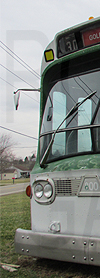
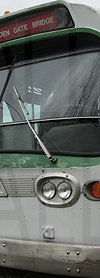
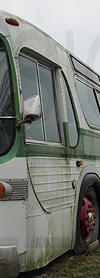
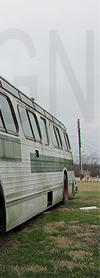

| Retired Golden Gate Transit GM New Look #800, shown here displaying a front route number rollsign similar to this, is seen in a private yard in western Ohio on March 7, 2016. |



| to go to the Golden Gate Transit electronic sign list page. |