| Rollsigns from Toronto, ON Subway System |
| This TTC Subway linen rollsign is a version RT5, and was off a subway car that spent most its existence at Wilson Carhouse. It has 17 exposures. The exposures are grouped together in that they show the stages of the subway's expansion: • Kennedy & Kipling at the top. • All the "Via Downtown"s together • Woodbine close to Keele • Warden close to Islington A YouTube video of this rollsign can be viewed below, right centre. |
| In 1954, the Toronto Transportation Commission changed its name to the Toronto Transit Commission, and became the sole provider of public transit in Toronto. On March 30, 1954, The TTC became the first transit property in Canada to operate a subway. The original route went from Eglinton Station, mostly paralleling Yonge Street, to Union Station. In 1963, the TTC expanded the subway service, creating the University line extending the line from Union Station back north under University Avenue to St. George Station, at Bloor Street West and Bedford Road. - In 1966, the Bloor-Danforth Subway opened running from Keele Station in the west, to Woodbine Station in the east, with transfers at Yonge Street and St. George Station to the original line. At Bay Street Station there were actually two stations created: The "Upper" station, which is still used today for through east-west service, and "Lower" Bay Station, which was used for a short lived service travelling from Woodbine Station to Downtown (Union Station). This service was discontinued after a short time, and the Lower Bay Station was abandoned. - In 1968 the TTC expanded the Bloor-Danforth line west to Islington Station on Bloor Street West, and east, then northeast to Warden Station, at St. Clair Avenue East. Later, in 1973, they expanded the Yonge Subway north to York Mills Station, and again in 1974 to Finch Station. In 1978, northward expansion continued with the opening of the Spadina Subway line, operating from St. George Station north then northwest to Wilson Station. The section between Eglinton West Station and Wilson Station operates down the centre of the W.R. Allen Expressway. In 1980, the TTC added its last expansion to the Bloor-Danforth line, extending it west to Kipling Station just south of Dundas Street West, and northeast to Kennedy Station at Eglinton Avenue East. - In 1985 rapid transit was extended further north and east to McCowan Road and Highway 401 with the opening of the Scarborough RT line. This line is a fixed route service with no short turn cross-over tracks, so no destination signs were created for these trains. In 1987, North York Centre Station opened between Finch and Sheppard stations. This was the last change to the subway system until 2002 when the TTC's newest line, the Sheppard Subway opened, operating between Yonge Street and Don Mills Road. On March 3, 2014, the TTC formally introduced numbers to represent the subway and rapid transit lines: Line 1 for the yellow Yonge-University-Spadina line, Line 2 for the green Bloor-Danforth line, Line 3 for the Scarborough RT, and Line 4 for the Sheppard Subway. The extension Line 1 (Spadina Line) from Downsview Station through York University into York Region to the Vaughan Metropolitan Centre near Jane Street and Highway 7 opened on December 18, 2017, adding six new stations to the line. |

| This TTC Subway hybrid rollsign was removed from a Greenwood Carhouse based subway car. It is also a version RT5, but has 18 exposures (not including the white gaps). This sign is very rare in that the first 3/4 of it is made of Tyvek (pressed paper), where the last 1/4 is linen. Until this sign was discovered, it was thought the TTC never used tyvek rollsigns, even in part. A photo of one of these rollsigns in a subway car is seen below, far right. |
| This TTC Subway linen rollsign is a version RT6, and was off a subway car that spent most its existence at Wilson Carhouse. It would have been printed sometime in or after 1985, as it uses the same letters as the all black bus destination signs introduced at the same time. It has 18 exposures. This version rollsign was also the last style linen rollsign to be produced in-house by the TTC. |
| This TTC Subway mylar rollsign is "unofficially" a version RT7. It has 14 exposures. Notes about the listings include: • Elimination of the "via Downtown" message, since all Yonge-University- Spadina trains go via downtown. • The inclusion of Downsview Station, which opened on March 31, 1996. • Having "Sorry... Not In Service" instead of just "Out Of Service", as the buses' electronic sign program had a similar message. • Including "Yonge Street" and "Don Mills" to reflect the pending opening of the Sheppard Subway. Ironically enough, these signs would be replaced before that opening. • Generally, updating the short turn station destinations to reflect the most frequent used turn-backs and track cross-overs. |


| TYVEK↑ LINEN↓ |



| Hit the SUBSCRIBE ICON at the end of the video! ↑ On RG's YouTube channel, give it a THUMBS UP, and hit the BELL to be notified of new uploads! |

| to go to the earliest Toronto Transit Commission electronic sign list page. |


| This TTC Subway mylar rollsign is "unofficially" a version RT9. This style was installed in, and delivered with, the later built (closer to 2001) Bombardier T-1 class subway cars. The sign has no print date on it. It has 14 exposures. This version rollsign was the second-last style of subway rollsign to be printed for the TTC. The next ordered series of subway cars, the Bombardier "Toronto Rocket" (TR) class, were delivered with LED electronic signs. |
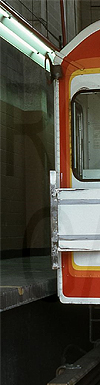



| Toronto Transit Commission H-5 Class subway car #5807, displaying a tyvek sign exposure identical to the one on the second rollsign image on this page, is shown posed at Greenwood Carhouse in 1981. (Photo from the collection of Rob Pineault. Used with permission.) |