| Rollsigns from Toronto, ON Streetcar System - Page 1 |
| This linen side route name sign is off the first "post-war" all electric PCC #4300. It is dated from 1965 and has 32 exposures. The "End" exposure was to let the operator know that they had reached the end of the sign when rolling. The numbers to the right of each exposure are the TTC's exposure ID number. |
| Streetcar service began in Toronto on September 11, 1861 with the incorporation of the Toronto Street Railway, using horse-drawn streetcars. After a reorganization in 1873, the City of Toronto took over all operations on May 20, 1891, but then relinquished control to the Toronto Railway Company on September 1, 1891. During the Toronto Railway Company's control, the first electric streetcars were introduced in 1892, and in 1894, horse-drawn streetcars ended operation. September 1, 1921 saw the end of service provided by the Toronto Railway Company. All services within the city limits were taken over by the Toronto Transportation Commission. From 1923 to 1927, the TTC acquired the interurban services that extended from Toronto. In 1925, the TTC introduced its first Peter Witt streetcars, and in 1938, purchased its first Presidents' Conference Committee (PCC) streetcars. On March 30, 1954, the Toronto Transportation Commission became what is now the Toronto Transit Commission (TTC). In 1963 the last of the Peter Witt streetcars were retired from regular service. Car #2766 was retained for historical value. For the next sixteen years, the PCC's were the workhorses of the TTC fleet. They acquired countless more from other cities that were retiring their streetcars, and in Toronto, continued to provide years of service. The TTC owned 754 PCC's in their history, the most by any one city. In 1995, however, the TTC finally retired its last PCC's from regular service, retaining cars #4500 and 4549 for charter and special event service in the city. |

| This linen front destination sign has 27 exposures. It is shown on the sign to be a version "11TR", although frequent updates occurred to these signs and the version number is likely incorrect. After route numbers were introduced on streetcar lines in 1985, the destination signs and route name signs were intermixed having exposures from each on the same sign. |
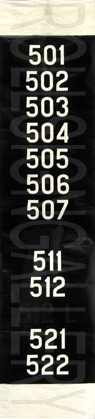
| This linen side number sign has 15 exposures. The obvious difference between the front and side number signs is the size of the numbers. The "512L" exposure represents the 512 St Clair route's short turn to Lansdowne Avenue. |
| This linen front number sign has 12 exposures. This basic number sign was produced closer to the end of PCC use in the system. The "512L" exposure has been blacked out - To parallel what was on the CLRV signs, short turn listings just used the main route number, and the final destination. (ex: 512 LANSDOWNE) |
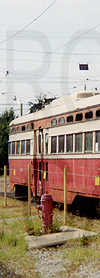
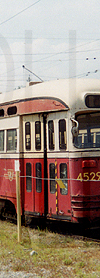
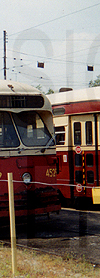
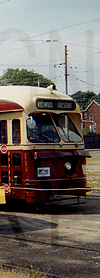
| Retired Toronto Transit Commission Presidents' Conference Committee (PCC) streetcar #4529 is seen with active PCC #4500 on a private charter at Wychwood (St. Clair) Carhouse, September 1, 1996. These were the type of streetcars that housed the signs on this page. |










| This rare one piece linen front route/destination sign was designed for one of the ex Kansas City Public Service streetcars the TTC acquired in 1957. Unlike others which had dual scroll front sign boxes, these cars had a single scroll sign box, so these special order rollsigns were produced. It reflects routes and destinations only along the St. Clair line as these cars ran exclusively from the now closed Wychwood Carhouse, on Wychwood Avenue just south of St. Clair Avenue West. This sign has no print date, but is from before the TTC started electric trolley bus service on Mt. Pleasant Road, with destinations like Eglinton and Moore Park. The sign has 20 exposures. This sign was graciously donated to RG by John McDonnell. |



Toronto Transit Commission 1946 built Presidents' Conference
Committee streetcar #4772 (a Class A-14 PCC streetcar by TTC records)
is seen westbound on St. Clair Avenue West at Dufferin Street in 1972. TTC
#4772 was formerly #782 operating for the Kansas City Public Service, and
was acquired by the TTC in 1957. These ex KCPS cars with their special
one piece front rollsigns like the one seen here, ran exclusively on the
St. Clair line and operated out of the now closed Wychwood Carhouse.
(Photo from the collection of Rob Pineault. Used with permission.)
Committee streetcar #4772 (a Class A-14 PCC streetcar by TTC records)
is seen westbound on St. Clair Avenue West at Dufferin Street in 1972. TTC
#4772 was formerly #782 operating for the Kansas City Public Service, and
was acquired by the TTC in 1957. These ex KCPS cars with their special
one piece front rollsigns like the one seen here, ran exclusively on the
St. Clair line and operated out of the now closed Wychwood Carhouse.
(Photo from the collection of Rob Pineault. Used with permission.)




| to go to the earliest Toronto Transit Commission electronic sign list page. |
